Showing posts with label Smartphones with Rear Dual Camera Module. Show all posts

Monday, 28 August 2017

New Samsung Galaxy J7+ With Dual Camera Brings Live Focus and Bixby To Mid-Level Category

It appears like it's only a matter of weeks now before the all-new Samsung Galaxy J+ gets officially launched in various countries in Southeast Asia, most likely including the Philippines.

An actual, working unit of the upcoming Android handset recently surfaced in a Cambodian tech video review channel on Youtube named "Cambo Report" and off hand, it seems like the smartphone will be introducing a number of fresh features to the company's midrange J-Series.

   
See more of it images.................

Wednesday, 23 August 2017

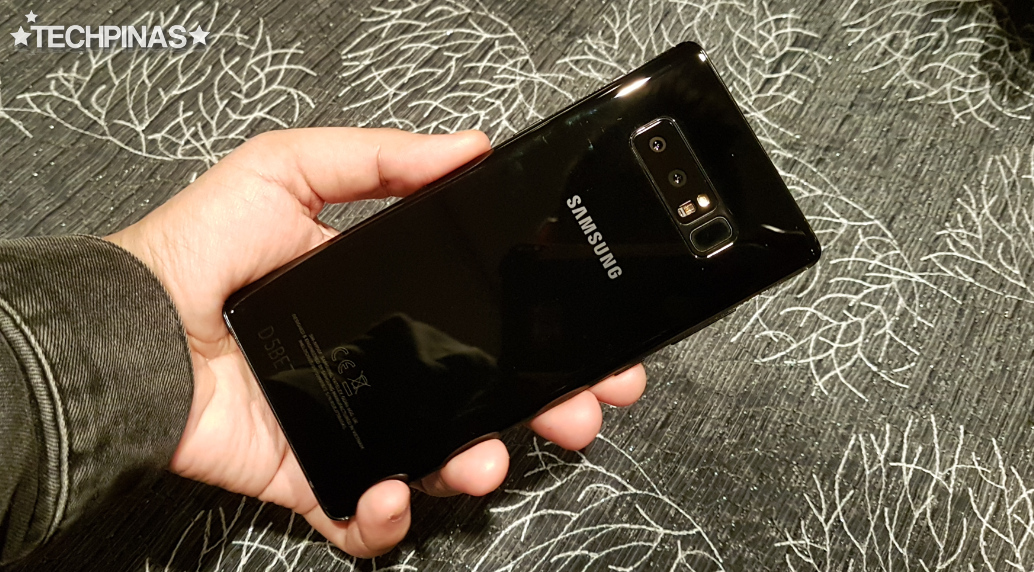
Samsung Galaxy Note8 Price in the Philippines is Php 49,990, Pre-Order Starts on September 8, 2017

Through an exclusive 'Unpacked!' media event held at the Shangri-La Hotel in Makati City on August 23, 2017, Samsung Mobile Philippines formally unveiled the 2017 iteration to their popular Galaxy Note flagship smartphone series.

Samsung Galaxy Note8

The follow-up to the infamous Samsung Galaxy Note7 of 2016 - which was recalled due to battery explosion hazard, the powerhouse Samsung Galaxy Note8 introduces a handful of "firsts" to this popular handset line by the Korean Giant.

Lets talk about these "firsts".


The SGNote8 is the first model in the Note series to don a Hardware-Home-Button-less Infinity Display, which is similar to what consumers will find on the Samsung Galaxy S8 and S8+. To be specific, the SuperAMOLED screen of this new phablet measures 6.3-inch and has a resolution of 1440 x 2960 pixels.


Also, this release is the first ever Galaxy Android smartphone to have a Dual Rear Camera module. Made up of Dual 12 MegaPixel optics with differing f/1.7 and f/2.4 apertures and field of views, this set-up gives Galaxy Note8 2X Lossless Zoom capability and LiveFocus, which is Samsung's version of Depth of Field or Bokeh Effect.

This background defocus effect is more or less similar to what you'll experience on the Apple iPhone 7 Plus. This mimics - to some extent - the bokeh effect that can achieved when using a DSLR with at least f/1.8 lens.

You can watch a demo of the Dual Camera features and learn more about the other key selling points of this new flagship phablet via our Quick Review video of the Samsung Galaxy Note8:


For those who enjoy taking videos, the phone's rear camera set-up also shoots 4K clips at 30 frames per second and benefits from Optical Image Stabilization as well as Auto-HDR for video recording.

Samsung Galaxy Note8's front-facing selfie camera has 8 MegaPixel resolution, f/1.7 aperture, and auto-HDR.


One of the key features and main selling points of the Note line is its S-Pen capacitive stylus support. And like its predecessors, this release will likewise have this -- with even more natural and more accurate handwriting support.

In terms of design and construction, the Samsung Galaxy Note8 looks and feels almost exactly like the Galaxy S8 and S8+ as it has the exact same glass-metal-glass sandwich build. The main difference is that this phablet has a more squarish or masculine footprint.


In terms of internal hardware, the new Note is more or less just as powerful as the older Galaxy S8 and S8+. In Asia, Galaxy Note8 units will run its Grace-UI-skinned Android 7.1 Nougat operating system with a 64-Bit Octa Core 10nm Exynos 8895 processor that's complemented by 6GB of RAM for multitasking, and expandable storage starting at 64GB.

Personally, I love the fact that flagship Galaxy models still have a 3.5mm audio jack. I often use a lapel microphone when recording videos using my handset for better quality and as such, I totally appreciate this feature. I would imagine that you'd also like this if you love listening to music on the go -- even if there are already many wireless earphones in the market.

Samsung Galaxy Note8 will be up for pre-order in the Philippines starting on September 8, 2017 until the 17th with prices starting at Php 49,990. The stylus-toting phablet will be out in a number of downright elegant colors, namely, Midnight Black, Orchid Grey, Deep Sea Blue, and Maple Gold.

Samsung Galaxy Note8 Philippines

Smart Communications, the Philippines largest network, will likewise offer the Samsung Galaxy Note8 bundled with their leading postpaid plans.

TechPinas Smartphone Technical Specs Table (TSTST)
Name : Samsung Galaxy Note8
Type : Slate Form Factor (Full Touchscreen), Phablet with Stylus
Price Category : High-End (Flagship Level)
Dimensions : 162.5 x 74.6 x 8.5 mm
Weight : (TBD)
Available Colors : Orchid Grey, Deep Sea Blue, Midnight Black, Maple Gold
Operating System : Android 7.1 Nougat with Grace UI
Display : 6.3 inches (~83.1% screen-to-body ratio), 1440 x 2960 pixels (~522 ppi pixel density), SuperAMOLED Infinity Display, capacitive touchscreen, 16M colors, Curved Corning Gorilla Glass 5
Processor : 64-Bit Octa Core 10nm Exynos 8895 Octa
RAM : 6GB RAM
Internal Storage : 64/128/256 GB ROM options, expandable via hybrid nano SIM2 slot
Camera : Back: Dual 12 MegaPixels, f/1.7 and f/2.4 apertures, Optical Image Stabilization (OIS), Phase Detection Autofocus (PDAF), 2X Optical Zoom, Dual Tone LED Flash
Front: 8 MegaPixels, f/1.7 aperture
Video Capture : Back - 4K 60fps, 1080p 120fps, 720p 240fps, Dual Video Recording, Video HDR
Front - 4K 30fps
Audio and Video Playback : MP3, WAV, eAAC+, FLAC, MP4, H.264
Ports : USB Type C 1.0 reversible, USB OTG, 3.5 mm audio jack
Connectivity : Wi-Fi 802.11 a/b/g/n/ac, Wi-Fi Direct, DLNA, Wi-Fi hotspot, Bluetooth v5.0 with A2DP, EDR, 3G HSPA+; LTE-A
GPS : A-GPS, GLONASS, BDS, GALILEO
FM Radio : No
Sensors : Accelerometer, Digital Compass, Proximity, Gyroscope, Fingerprint Scanner, Iris Scanner, Heart Rate, Barometer
Network : 2G bands GSM 850 / 900 / 1800 / 1900 - SIM 1 and SIM 2
3G bands HSDPA 850 / 900 / 1900 / 2100
4G bands LTE band 1(2100), 3(1800), 5(850), 7(2600), 8(900), 20(800), 28(700), 38(2600), 40(2300)
SIM Card Type : Dual nanoSIM
Battery : Non-removable 3,300 mAh Li-Po battery with Qi Wireless Charging and Fast Charge support
Uptime : TBD
Value-Added Features : Dual Camera Module, S-Pen Stylus Support, Infinity Display, New Design, Iris Scanner, Bixby Assistant, Improved Selfie Cam, Samsung Desktop Experience
Announcement : Philippines - August 23, 2017 via Unpacked! Event
Availability : Philippines - September 23, 2017
Price : Official SRP in the Philippines - Php 49,990

Sunday, 20 August 2017

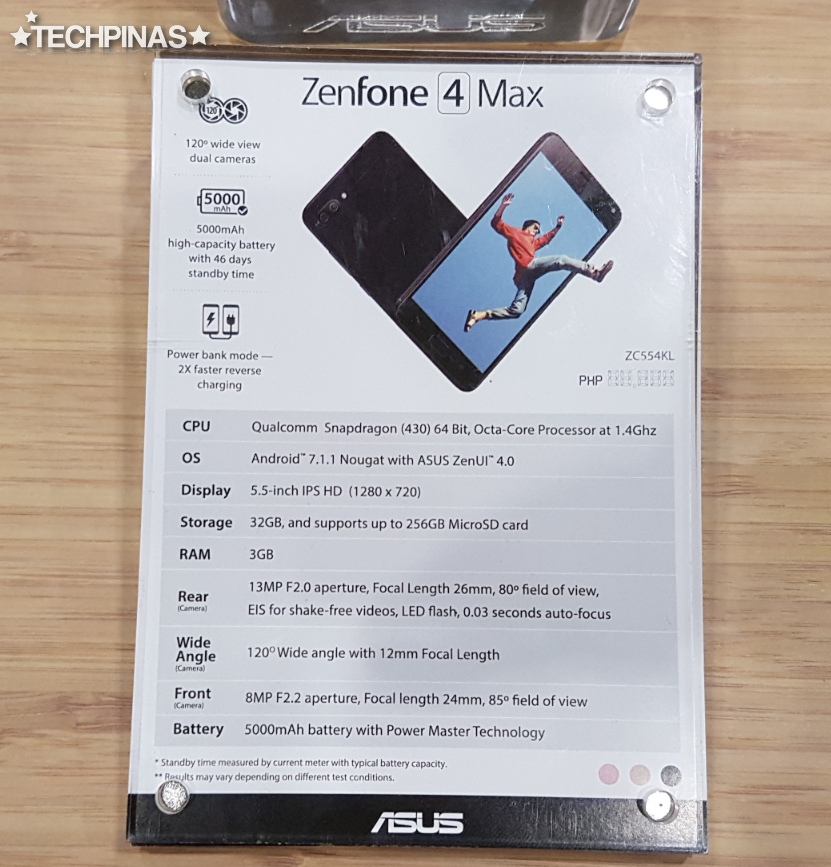
Asus ZenFone 4 Max Philippines Price, Specs, Initial Review, Dual Camera Feature Explained

Donning an official suggested retail price of Php 9,995 in the Philippines, the all-new Asus ZenFone 4 Max is the most affordable of the give new Android smartphones that Taiwanese electronics company Asus officially unveiled via their media and consumer event held last Saturday - August 19, 2017 - at the SMX Convention Center in Pasay City.


Although the metal shell and overall footprint of Asus ZenFone 4 Max ZC554KL are largely the same as that of its predecessor - the Asus ZenFone 3 Max - which was released earlier this year, this new model does offer a number of enhancements in specs as well as fresh features that we're seeing for the first time in the Max series.

Asus ZenFone 4 Max ZC554KL

The face of the handset gives you two new obvious enhancements coming from the older model. To specific, there's now a physical home button below the display, which features a Fingerprint Scanner for quickly unlocking the device all while making it more secure.


Also, above the 5.5-inch HD IPS display, underneath the 2.5D Curved Glass touchscreen, you'll find the Soft LED Flash for the 8 MegaPixel f/2.2 front-facing camera, which comes in handy when snapping selfies in low to zero lighting conditions.


Sidenote: Asus ZenFone 4 Max's aluminum unibody enclosure looks and feels almost exactly like the shell of the Asus ZenFone 3 Max, which is not a bad thing given that the earlier release was one of the better-looking handsets in its price category. On a separate note, the concentric Zen design element of this new smartphone is found on the real metal volume and power buttons.


Another notable improvement implemented on the ZF4Max is its even bigger battery pack! Whereas the 5.5-inch ZF3Max was powered by an already big 4,100 mAh Li-Ion battery, the follow-up has an even higher capacity 5,000 mAh non-removable pack, which ensures longer uptime with regular use and gives more juice when the phone is used as a powerbank via reverse charging.

Asus ZenFone 4 Max ZC554KL

Apart from the larger battery, my favorite new feature of the Asus ZenFone 4 Max ZC554KL is its Dual Rear Camera module, which is made up of two 13 MegaPixel optics with varying field of view.

Regular or Standard View

Wide-Angle View using the secondary camera

Notice the subtle protrusion of the Dual Camera Module at the back.

The first lens has a standard 80-degree field of view while the other is wide-angle at 120-degrees. Hence, with this Dual Cam set-up, you can capture a wider view of the subject in front of you with just a click of a button -- no need to take a few steps back. This comes in handy when taking photos of buildings or even groups of people.


As I've mentioned above, Asus ZenFone 4 Max supports reverse charging, which gives it powerbank functionality. Simply use the USB-On-The-Go cable provided in the package to use this phone as a power source for your other mobile devices, including other Android smartphones.

Asus ZenFone Reverse Charging Powerbank Feature
Connecting your other smartphone to the Asus ZenFone 4 Max via charging cable and USB-OTG instantly activates Reverse Charging or Powerbank feature.


On the software side, the biggest enhancement that Asus fans will experience on this model is its new ZenUI 4.0 interface for Android 7.1.1 Nougat operating system. This version of the UI is simpler and has fewer bloatware, giving users a near-vanilla Android experience and eliminating unnecessary apps and processes running in the background.

Overall, I think all these improvements make the Asus ZenFone 4 Max a great option for consumers who are looking for a fairly affordable mid-level 2017 Android smartphone -- even if some say that the internal hardware - which include the Qualcomm Snapdragon 430 chipset, 3GB of RAM, and 32GB of expandable storage - could have been better.

If anything, however, I wish the company retained the Full HD resolution of the Asus ZenFone 3 on this refresh. But I understand that to keep the price of the device low all while incorporating new parts, they had to make such compromises. Not so sure, though, how fans of the brand will take this.

Asus ZenFone 4

For those who are interested, Dual SIM 4G-enabled Asus ZenFone 4 Max ZC554KL is now available at all Asus Concept Stores and partner dealers across the Philippines. It's out in three classy colors, namely, Sand Gold, Rose Pink, and - the one I have here - Titanium Gray.

TechPinas Smartphone Technical Specs Table (TSTST)
Name : Asus ZenFone 4 Max ZC554KL
Type : Slate Form Factor (Full Touchscreen)
Price Category : Midrange
Dimensions : 154 x 76.9 x 8.9 mm
Weight : 181 grams
Available Colors : Rose Pink, Sand Gold, Titanium Gray
Operating System : Android 7.1.1 Nougat with ASUS ZenUI 4.0
Display : 5.5 inches (~70.4% screen-to-body ratio), 1280 x 720 pixels, S-IPS LCD, capacitive touchscreen, 16M colors, 2.5D Curved Corning Gorilla Glass
Processor : 64-Bit Octa Core 1.4 GHz ARM Cortex-A53, Adreno 505 GPU, Qualcomm MSM8937 Snapdragon 430 chipset
RAM : 3GB RAM
Internal Storage : 32GB ROM, expandable via dedicated microSD card slot supporting up to 256GB
Camera : Back: Dual 13 MegaPixels, f/2.0 aperture, autofocus, LED flash, standard 80-degrees and wide-angle 120-degrees field of view
Front: 8 MegaPixels, f/2.2, LED flash, 85-degrees field of view
Video Capture : Front and Back: Full HD 1080p 30 frames per second
Audio and Video Playback : MP3, WAV, eAAC+, FLAC, MP4, H.264
Ports : microUSB 2.0, USB On-The-Go, 3.5 mm audio jack
Connectivity : Wi-Fi 802.11 a/b/g/n, Wi-Fi Direct, DLNA, Wi-Fi hotspot, Bluetooth v4.1 with A2DP, EDR, 3G HSPA+; LTE Cat4
GPS : A-GPS, GLONASS, BDS
FM Radio : Yes
Sensors : Accelerometer, Digital Compass, Proximity, Gyroscope, Fingerprint Scanner in front
Network : 2G bands GSM 850 / 900 / 1800 / 1900 - SIM 1 and SIM 2,
3G HSDPA 850 / 900 / 1700(AWS) / 1900 / 2100
4G bands LTE band 1(2100), 3(1800), 5(850), 7(2600), 8(900), 20(800), 40(2300)
SIM Card Type : Dual nanoSIM
Battery : Non-removable 5,000 mAh Li-Po battery
Uptime : 3 Days of Regular Use (TBC)
Value-Added Features : Big Battery, Dual Camera Module with Wide Angle Shot, Front Flash, Aluminum Alloy Shell, Reverse Charging
Announcement : Philippines - August 19, 2017
Availability : Philippines - August 2017
Price : Official Suggested Retail Price in the Philippines - Php 9,995

Thursday, 17 August 2017

Nokia 8 Official Price is €599 Euros or $700 USD : Continuing The Great Nokia Cameraphone Legacy

Tech enthusiasts who are familiar with Nokia's long history as a handset maker would know that the Finnish Giant was particularly popular and respected for doing two things:

1. Crafting very durable phones
2. Making the best cameraphones

The old Nokia 3310 is a testament to the first phrase while smartphones like the Nokia N8, Nokia 808 PureView, and Nokia Lumia 1020 - to this day - speak about the company's capabilities when it comes to creating mobile devices that can work as an alternative to your traditional digital camera.


Although the all-new Nokia 8 Android smartphone by HMD Global merely bears the name of the Finnish Giant and is not really crafted by "the Nokia of old", I'm still hoping that it can somehow be a decent follow-up to those models. I mean, it's been so long since a good cameraphone with the name Nokia printed on it was released in the market. It would be a shame if it won't be as good as advertised. Heck, I want this model to be commercially successful.


Anyway, what's great is that Nokia 8 has several things going for it.

For one, 8 - historically - is a magic number for Nokia. During its heydays, Nokia would always affix the number 8 to it handset models sporting the best imaging features. So I'm sure fans of the brand would immediately associate "great camera" with this release without HMD Global having to explain too much.


Second and more importantly, Nokia 8 is the first handset by HMD Global to have Carl Zeiss optics. You see, what made all those Nokia cameraphones that I mentioned above the absolute best during their time was in large part because of the Finnish company's partnership with German optics maker, Carl Zeiss. For those who are not familiar with it, Carl Zeiss is one of the oldest and most respected optics manufacturers in the world.


And finally, of course, compared to its predecessors, the Nokia 8 already incorporates today's leading innovations in terms of internal hardware, display quality, audio technology, and even design and build -- all to better deliver a vastly enhanced mobile imaging experience.


I've just seen several videos on Youtube about the Nokia 8 and off hand, here are eight features highlighted in the clips that got me really excited to see this cameraphone in the flesh and to play it:

1. Dual Camera Module incorporating a 13 MegaPixel RGB camera with Carl Zeiss lens plus another 13 MegaPixel monochrome shooter - This set-up is largely the same as that of Huawei P9, P9 Plus, P10, and P10 Plus and should result in shots with better contrast and clarity in various lighting conditions.

2. Nokia OZO Audio with spatial 3D recording, which even better than stereo and should deliver a more immersive and enjoyable AV experience.

3. Full-length graphite-shielded copper cooling pipe for the 10nm Qualcomm Snapdragon 835 processor ensures better heat management and lag-free performance when you're playing the most specs-intensive games that you can download from Google Play Store.

The powerful and energy efficient processor is complemented by two sets of internal hardware that consumers can choose from: 4GB RAM / 64GB ROM combo for the Tempered Blue, Steel, and Polished Copper variants and 6GB RAM / 128GB ROM combo for the Polished Blue version

4. 13 MegaPixel front-facing selfie camera with 4K 30fps video recording capability, which is great for those who want to start recording and uploading vlogs on Youtube and Facebook.

5. 'Bothie' shooting mode where you do split screen video recording using both the front and rear cameras simultaneously and go live on Facebook or Youtube!


6. IP54 splash-proof build and availability in four elegant colors, namely, Polished Copper, Steel, Tempered Blue, and Polished Blue. Nokia 8 can be a great companion be it outdoors while you're on adventure or when you're inside the boardroom for your corporate role.

7. Nokia 8 is the first Nokia-branded smartphone to have a pixel-dense Quad HD display! This model has a 5.3-inch 1440 x 2560 pixels IPS display that guarantees an enjoyable experience whether you're browsing photos or watching videos.

8. Not only is the non-removable 3,090 mAh Li-Ion battery rather big given Nokia 8's display size but it also supports Qualcomm Quick Charge 3.0 that greatly shortens the time it takes to fully charge the pack.


That's a lot to look forward to, right? Again, I can't wait to take Nokia 8 for a spin -- just to see for myself if it's a worthy addition to the long line of great Nokia cameraphones.

The official suggested retail price of Nokia 8 with Dual Carl Zeiss Optics is 599 Euros or Php 36,200 with current conversion. On the other hand, its release date in several key markets around the world will be on September 23, 2017.

TechPinas Smartphone Technical Specs Table (TSTST)
Name : Nokia 8
Type : Slate Form Factor (Full Touchscreen)
Price Category : High-End (Flagship Level)
Dimensions : 151.5 x 73.7 x 7.9 mm
Weight : 160 grams
Available Colors : Tempered Blue, Polished Blue, Steel, Polished Copper
Operating System : Android 7.1.1 Nougat
Display : 5.3 inches (~69.4% screen-to-body ratio), 1440 x 2560 pixels (~554 ppi pixel density), IPS LCD, capacitive touchscreen, 16M colors, 2.5D Corning Gorilla Glass 5
Processor : 10nm 64-Bit Octa-core (4 x 2.45 GHz Kryo) + (4 x 1.9 GHz Kryo), Adreno 540 GPU, Qualcomm MSM8998 Snapdragon 835 chipset
RAM / Internal Storage Options: 4GB RAM / 64GB ROM - Tempered Blue, Steel, Polished Copper
6GB RAM / 128GB ROM - Polished Blue
MicroSD Card Slot : Yes, via Hybrid Secondary NanoSIM Slot, not Dedicated
Camera : Back: Dual 13 MegaPixel, Carl Zeiss Optics, f/2.0 aperture, Laser and Phase Detection AutoFocus (PDAF), Optical Image Stabilization (OIS), Dual Tone LED Flash
Front: 13 MegaPixels
Video Capture : Front and Back: 4K 2160p 30 frames per second, Full HD 1080p 30 frames per second
Audio and Video Playback : MP3, WAV, eAAC+, FLAC, MP4, H.264
Ports : USB Type-C 1.0, 3.5 mm audio jack
Connectivity : Wi-Fi 802.11 a/b/g/n/ac, Wi-Fi Direct, DLNA, Wi-Fi hotspot, Bluetooth 5.0, A2DP, LE, EDR, 3G HSPA+; 4G LTE-A
GPS : A-GPS, GLONASS, BDS
FM Radio : Yes
Sensors : Accelerometer, Digital Compass, Proximity, Gyroscope, Fingerprint Scanner, Heart Rate
Network : 2G bands GSM 850 / 900 / 1800 / 1900 - SIM 1 and SIM 2,
3G HSDPA 850 / 900 / 1900 / 2100
4G LTE band 1(2100), 2(1900), 3(1800), 4(1700/2100), 5(850), 7(2600), 8(900), 20(800), 28(700), 38(2600), 39(1900), 40(2300), 41(2500)
SIM Card Type : Dual nanoSIM
Battery : Non-removable 3,090 mAh Li-Ion battery with Qualcomm Quick Charge 3.0 (18W, 5V/2.5A, 9V/2A, 12V/1.5A)
Uptime : TBD
Value-Added Features : Dual Camera Module (RGB and Monochrome), Nokia OZO Audio, Bothie Mode, IP54 Splashproof Build, Aluminum Shell, High-Gloss Finish for some variants, Copper Cooling Pipe, Quad HD Display, 4K Front Video Recorder
Announcement : Global - August 17, 2017
Availability : Global - September 2017
Price : Official SRP - 599 Euros

Wednesday, 16 August 2017

Samsung Galaxy Note8 Dual Camera Features Explained

Considering how accurate leaks about the Samsung Galaxy Note 3, 4, 5, 6, and Note7 had been, there's a big chance that a lot of things we are reading right now about the upcoming Samsung Galaxy Note8 are already on-point.


For one, I believe all these leaked press photos of the 2017 flagship phablet by the Korean Giant posted by Evan Blass on Twitter are the real thing. (We should all thank him, really.)

Also, the rumored technical specifications of the device (coming from various 'insiders' and 'experts'), including the 6.3-inch 1440 x 2960 pixels SuperAMOLED Infinity Display, 8 MegaPixel f/1.7 front cam, 10nm 64-Bit Exynos 8895 Octa processor, 6GB of RAM, plus the 64GB and 128GB expandable storage options could very well be true.


Of course, S-Pen stylus support is to be expected. Otherwise, this model won't be worthy of being in the Note line.


But of all "leaked" features of the Samsung Galaxy Note8, the Dual Camera Module at the back - beside the oddly placed Fingerprint Scanner - is the one that I'm most curious about.

According to reports, it's made of two 12 MegaPixel Dual Pixel optics with differing f/1.7 and f/2.4 apertures.

Why? Well, it's because this stylus-toting phablet is the first mobile device by the Korean Giant to don this particular imaging set-up. Lots of questions pop in my mind whenever I look at it in photos: "What can it do exactly?" "Is it going to be a lot better than what's on the Apple iPhone 7 Plus?"

Thankfully, just recently, a website dedicated to keeping Galaxy fans in Netherlands abreast with the latest that Samsung has to offer in the mobile game posted leaked presentation slides on all the possible capabilities of the all-new Samsung Galaxy Note8 Dual Rear Camera. (source)

Let's go through the slides, one by one:

1. 3X Optical Zoom called "Smart Zoom"

It appears that the secondary 12 MP camera will have a telephoto lens that will allow Note8 to have three times optical zoom capability, which is impressive given that other high-end Dual Camera smartphones can these days can only 2X or 2.3X lossless zoom.


2. Refocus or Playing with Bokeh Effect

Aside from making 3X lossless zoom possible, the secondary cam also measures and maps out the location of each possible subject in a shot in 3D, which then allows the user to change the focus in the resulting images and applying beautiful bokeh or blur effects, mimicking what a DSLR can deliver.


3. Super Night Shot for Clearer and Most Crisp Photos in Low Light Conditions

Apparently, Samsung has found a way to make two cameras work together to deliver brighter and more brilliant photos even in settings where there's little ambient light. How is it done? We don't know yet but of all the rumored capabilities of Note8's Dual Camera Module, this is the one that I find most interesting. Will definitely wait for Samsung's explanation of this feature during the launch of the phablet.


4. Perspective View

With the two cameras positioned differently, they can snap photos with different perspectives when you press the shutter button. This lets you rotate the shot and pick the perspective you prefer after taking the photo.


5. Background Effect

According to the Dutch site, with the Dual Camera's ability to zoom in and measure depth, other more psychedelic tricks are also possible; Samsung calls this 'Background Effect'. This comes in handy if you want to add a particular mood and feel to your images.

Now, I don't know about you -- but considering all the key features and imaging capabilities of the Samsung Galaxy Note8, I think it could very well be the absolute best smartphone that you can get this year. For me, it represents the very pinnacle of what Samsung could deliver in this product category. Needless to say, I'm very impressed with everything I'm learning about this model. Can't wait to see it in the flesh and to play with it!

Samsung Galaxy Note8 will be officially unveiled by the Korean Giant via an exclusive media event happening in New York on August 23, 2017. As for its price, insiders believe that the top-of-the-line phablet should go for around $1,000 USD or roughly Php 51,000 with current conversion.

Wednesday, 9 August 2017

Lenovo K8 Note Price, Specs, Press Photos : Splash Resistant, Has Dual Camera and Deca Core Processor

On Thursday - August 10, 2017, Chinese handset maker Lenovo officially launched a new Android smartphone in India, marking one of its first moves to regain lost ground in the midrange price bracket.

The fairly affordable Lenovo K8 Note has a number of attractive features that make it a good alternative to other mid-level handsets by other brands from China that have taken over the market.


The biggest selling point of this model would have to be its Dual Real Camera module made up of a 13 MegaPixel PDAF optic with f/1.7 aperture and Dual Tone LED flash plus another 5 MegaPixel lens that work together to deliver shots with interesting bokeh or depth of field effects. This is largely similar to what Huawei's GR line currently offers.

Users who love to take selfies will also surely appreciate the 13 MegaPixel f/2.0 front camera with Soft LED flash that allows the user to snap clear and crisp self-portraits even in low to zero lighting conditions. Of course, this shooter also benefits from Lenovo's very own beautification software.


Another notable feature is the phone's Mediatek Helio X23 chipset, which has a whopping ten physical cores! The four ARM Cortex-A53 cores clocked at 1.4GHz, four ARM Cortex-A53 cores clocked at 1.85GHz, and two ARM Cortex-A72 cores clocked at 2.3GHz combine to make Lenovo K8 Note one of the most powerful handsets in its price echelon. This chip likewise incorporates a Mali-T880 MP4 GPU for decent 3D gaming experience and is complemented by either 3GB or 4GB of RAM and 32GB or 64GB of internal storage that's expandable via a dedicated microSD card slot.


For those who hate always charging their handsets via powerbank or electrical outlet just so it won't run out of juice on the way home in the evening, you'll be glad to know that Lenovo K8 Note is powered by a non-removable 4,000 mAh battery pack, which - I think - is just right for a handset with a large 5.5-inch Full HD IPS display. Expect a whole day of uptime - and a bit more - from this phablet with regular use.

Unlike other K-series models from Lenovo in the past, Lenovo K8 Note will no longer have the Vibe user interface as serving as skin for the operating system. This one will run the stock version of Android 7.1.1 Nougat right out of the box.

And finally, here's a feature that puts this model ahead of its competition: Lenovo K8 Note has a splash-resistant build and finish!

Apart from being crafted from aluminum making it look and feel both durable and elegant, the shell is also closely sealed to protect against accidental splashes of water. It's not particularly water-proof so you can't dive with it -- but such level of protection, made possible in part by water-repellent nano-coating - is definitely welcome in a midrange handset.

So how much will it be? As I've noted, Lenovo K8 Note will be available in two variants when it hits store shelves in India come August 18. The 3GB RAM with 32GB ROM variant is priced at INR 12,999 ($203 USD or Php 10,300) and the 4GB RAM with 64GB ROM version goes for INR 13,999 ($219 USD or Php 11,100). This handset will be out in two colors, Venom Black and Fine Gold.

The Philippines usually also gets Lenovo Android smartphones that are launched in India -- albeit a bit later. Here's to hoping that this one would get released here real soon. I mean, Lenovo K8 Note sure looks promising.

Monday, 31 July 2017

Cherry Mobile Desire R8 Giveaway, Unboxing, Key Features Check

Cherry Mobile Desire R8 is currently the flagship smartphone or top-of-the-line release of the proudly Pinoy handset company. And as such, it has the best design and build as well as set of technical specifications out of all mobile devices that the brand offers as of writing.

As a sign of gratitude to my readers and to allow one of you to fully experience the best that Cherry Mobile has to offer, I have decided to raffle of my own Cherry Mobile Desire R8 unit.


Before I give you my mechanics for the raffle, let's do a quick unboxing of this cool model just to show you everything that you're getting.


The Desire Series is the Cherry Mobile's latest line of premium line smartphones -- and that's well reflected in this phone's packaging. The outer sleeve has deep red, black, and gold hues that blend well together to exude an air of elegance.


At the back of the outer sleeve, we find a list of Cherry Mobile Desire R8's key technical specifications, including the 5.5-inch Full HD IPS OGS display protected by 2.5D Curved Gorilla Glass 3 touchscreen, Dual Camera Module - made up of a 13 MegaPixel main shooter plus a secondary 5 MegaPixel lens, an 8 MegaPixel front cam for selfies with Soft LED flash, Fingerprint Scanner for quickly unlocking the phone, USB Type C port, and non-removable 3,000 mAh Li-Ion battery pack.

Under the hood, this Dual SIM, 4G-LTE-enabled phone runs its near vanilla Android 7.0 Nougat operating system with a 64-Bit Octa-Core 1.5 GHz MediaTek MT6750T chipset that incorporates a Mali-T860 GPU, handles multitasking with 3GB of RAM, and comes with 32GB of internal storage that can be beefed up using the hybrid secondary nanoSIM slot that supports microSD card memory expansion. This set of innards gives this model an Antutu Benchmark Score in the range of 43,000 to 45,000, which reflects decent - albeit not exemplary - 3D gaming experience and overall performance.


Pulling the outer sleeve off, we see the plain black box -- which, unlike the ones for the Cosmos line, doesn't have the image of the phone printed on top.


Lifting the lid, we are greeted by the Cherry Mobile Desire R8 with the familiar screen protector - showing a list of the phone's specs - and the soft foam cradle protecting the device during shipment.


This is the complete retail package, which you can purchase for Php 9,999 at all Cherry Mobile Concept Stores, kiosks, and partner retailers nationwide.


The pack includes the unit itself, the 2A charger, the USB Type C cable, user manual, Cherry Mobile App list, SIM tray ejector pin, and earphones with in-ear silicone buds and microphone.


Design-wise, I'd say that the Cherry Mobile Desire R8 looks like a mash-up between the OPPO F1s and the Huawei Mate9. It has a 'square with rounded corners' footprint and its shell is made predominantly of anodized aluminum. Surprisingly, despite having a rather thick metal frame, the phone feels light compared to the far heavier Cherry Mobile Cosmos Three, which has similar build.


If you're wondering, the handset's Dual Camera set-up lets the user apply interesting bokeh or depth of field effect on the photos, ranging from f/9.0 to f/0.8 for maximum background blur behind a clear subject.


Now, as for our giveaway, we've decided to do it via Rafflecopter. It's very easy to join, simply use the widget below to complete all requirements and to send your entries:

a Rafflecopter giveaway

Join now and let your friends know about our giveaway!