Showing posts with label Versus. Show all posts

Tuesday, 15 August 2017

Smart Communications is Again The Largest Mobile Network in the Philippines

Following its efforts to improve its prepaid and postpaid offerings, Smart has managed to retake the lead from its erstwhile rival Globe Telecom to become the leading mobile services provider in the country as of Q2 2017.

Smart Communications

According to a recent GSMA Intelligence Data report (source), Smart got a 51.4% market share by the end of June 2017 while Globe’s share was at 48.2%, representing a 2% drop from its share during the end of 2016.

After it lost the top spot to Globe in January 2017, Smart Communications beefed up and streamlined its prepaid and postpaid packages, making them more enticing to Pinoy mobile consumers. To be specific, the MVP-company added more mobile data allocation to prepaid promos all while including Free Facebook experience to some packs. Likewise, Smart started to bundle high-end or flagship-level smartphones across the board, even to entry-level and midrange postpaid plans.

References:
1. Smart All Out Surf vs Giga Surf Prepaid Promos
2. Smart Postpaid Plans Get Bigger Data Allocation
3. Smart Offers Samsung Galaxy S8 and S8+ Starting at Postpaid Plan 399

By the end of 2016, Smart had 62.76 million customers compared to Globe's 62.8 million. Fast forward to March 2017, Smart's total subscriber base grew to 63.1 million while Globe’s figures dropped to 58.6 million.

Both Smart Communications and Globe Telecom have yet to release an official statement on the Q2 2017 GSMA Intelligence Data Report.

Disclosure: Mark Milan Macanas, the founder and sole blogger running TechPinas.com, is currently an Online Ambassador and Digital Influencer of Smart Communications.

Saturday, 8 July 2017

Samsung Galaxy J7 Pro vs OPPO F3 Specs Comparison Review, Price Fight in the Philippines

The Korean Giant's 2017 mid-level powerhouse release Samsung Galaxy J7 Pro is now up for pre-order in the Philippines and will officially become available in stores across the country come July 15, 2017. Once that model lands, it will go head to head with the very popular OPPO F3 Selfie Expert, which is the best-selling upper midrange smartphone in the Philippines for the first half of 2017.

For those who are currently trying to decide which of these two to get with their Php 15,990, which is the exact official suggested retail price of either models, I made this blog entry for you.

OPPO F3 vs Samsung Galaxy J7 Pro

To make it easier for all of us to spot the key differences between these two midrange selfie-centric handsets, let's check out the TechPinas Smartphone Technical Specifications Comparison Table below:

OPPO F3 vs Samsung Galaxy J7 Pro

Dimensions

OPPO F3 measures 153.3 x 75.2 x 7.3 mm while Samsung Galaxy J7 Pro has dimensions of 152.4 x 74.7 x 7.9 mm. OPPO's phone is slimmer while the Samsung's offering has a smaller footprint -- both by a bit. I'd say they're pretty even in this department.

Design and Construction

Both handsets flaunt a real metal shell and an overall aesthetic that's frankly reminiscent of the Apple iPhone. Which one looks better? It depends on the user's preference. Though, I want to note that the J7 Pro does have a unique looking U-shape antenna band design at the back, which - for me - makes it appear more interesting.

Display Quality

OPPO F3 and Samsung Galaxy J7 Pro both have similar 5.5-inch screen with Full HD resolution. In terms of size and pixel density (clarity), they're practically the same. Make makes them different is the display type. The Galaxy release feature's Samsung's very own SuperAMOLED display while the OPPO handset has IPS. Both look good in various viewing angles but SuperAMOLED has more vibrant colors with greater saturation while IPS shows more realistic hues, which some consumers might prefer.

Rear Camera

On paper, this is an area where the Galaxy J7 Pro can have clear superiority over its rival largely because of its 13 MegaPixel PDAF camera's very wide f/1.7 aperture, which allows it to perform very well in low light conditions. I'd love to try the camera first, though, to confirm this since software is also essential in boosting a cameraphone's low light capabilities.

Front-Facing Selfie Camera

The key-selling point of the OPPO F3 is its Dual Front-Facing Camera module which is comprised of a 16 MegaPixel autofocus f/2.0 lens plus an 8 MegaPixel fixed focus wide-angle f/2.4 optic; A Set-up that comes in handy for taking both standard selfies and groufies. Samsung Galaxy J7 Pro, on the other hand, has a 13 MegaPixel f/1.9 front cam with Soft LED flash that boosts its performance in low to zero lighting conditions. While I think both phones have stellar Beautification Modes for selfies, I personally believe OPPO F3 would be a finer choice for users who particularly enjoy taking photos of themselves alone or with their friends and loved ones; This is largely because of the Dual Camera module makes the Chinese handset maker's phone more flexible for this purpose. Also, it has bright screen flash which can somehow compensate for a lack of a Soft LED front-flash.

Internal Hardware and Gaming Performance

Apart from the selfie-camera set-up, this is an area where OPPO F3 is obviously superior to the Samsung Galaxy J7 Pro. The Chinese model's innards include the 64-Bit Octa Core ARM Cortex A53 based MediaTek MT6750T processor, 4GB of RAM, and 64GB of expandable storage. In comparison, the Korean release has a 64-Bit Octa Core ARM Cortex A53 based Exynos 7870 Octa chipset and just 3GB of RAM plus 32GB of expandable storage. I don't have to tell you which one would give you smoother multitasking experience and more storage space for your files. Also, OPPO F3 - on paper - should be able to deliver better 3D gaming performance with its more powerful Mali-T860 MP2 GPU versus just Mali-T830 MP2 inside the Samsung Galaxy J7 Pro.

Battery Size

The Samsung Galaxy J7 Pro is the winner in this department - albeit not by much - as it has a 3,600 mAh Li-Ion battery versus just 3,200 mAh powering the OPPO F3. What's interesting to find out, though, is if J7 Pro can indeed last longer with regular use. We have to remember that uptime is also a function of the processor's energy efficiency apart from the battery capacity.

Notable Similar Features

Both handsets are equipped with a Fingerprint Scanner for quickly unlocking the interface with but a touch of a finger, a dedicated microSD card slot so the user won't have to sacrifice Dual SIM capability to get more storage space, Full HD 30fps video recorder, and 4G LTE support.

So based on their specs alone, which handset is a better purchase at Php 15,990?

It's a mixed bag, really. Studying their specs sheets, it would be hard to say which model is clearly superior across the board compared to the other. Samsung Galaxy J7 Pro sports a rear camera with wider aperture that's supposed to perform better in low light plus it has a larger battery pack. On top of that, some users might prefer its brilliant SuperAMOLED display over IPS. But we also have to consider that OPPO F3 has a Dual Front Facing camera, which should be more powerful and flexible in snapping selfies and groufies plus it has a far better set of internal hardware that ensures a butter smooth mobile experience. As a wrap-up, I'd say that it's good that the two phones have their own unique strengths and main selling points so the consumer just needs to weigh which specs and features are more important to him or her when making the big decision.

I hope you found this TechPinas Specs Comparison Review helpful. If you did, kindly share this entry with your friends on social media so they can benefit from it too. Thanks!

Monday, 26 June 2017

Old Nokia 3310 Phone vs New 2017 Nokia 3310 Design and Features Comparison, In Photos

For my ABS-CBN News Channel Future Perfect guesting the other week, our friends from HMD Global Philippines and my good friend Mr. Karel Holub of argomall lent me units of the re-imagined 2017 version of the Nokia 3310 as well as one old Nokia 3310 from 2000. (Really, what would I be without my helpful and supportive friends?)

I took the liberty of snapping these side-by-side comparison photos of the phones as reference for those who are wondering how the new Nokia 3310 fares against the old version in terms of design and dimensions.

New Nokia 3310 vs Old Nokia 3310
2017 Nokia 3310 vs 2000 Nokia 3310, respectively.

New Nokia 3310 vs Old Nokia 3310

The new model has dimensions of 115.6 x 51 x 12.8 mm while the old one measures 113 x 48 x 22 mm. The 2017 release is taller and wider than the 2000 model by around 2 millimeters but it is far slimmer or thinner, making it easier to hold and keep in the pocket.


The re-imagined Nokia 3310 is also far lighter, weighing only around 80 grams while its near-ancient predecessor weighs in at 133 grams.


Apart from its obvious heft, the old Nokia 3310 thicker plastic exterior and interior parts made it heavier. Though, these are also the elements that made this model a legend when it comes to sheer durability.


In a future TechPinas post, I will talk about some features of the 2017 Nokia 3310 that make it a good purchase at Php 2,490 here the Philippines.

For now, let me share the features that make it far better than its predecessor, which sold for around Php 8,000 brand new, 17 years ago.

New Nokia 3310 vs Old Nokia 3310
Of course, the screen is now bigger at 2.4 inches and is even colored! You can even change the background photo and the interface is likewise more intuitive and easier to navigate.

2017 Nokia 3310 vs 2000 Nokia 3310
Another notable new feature is the 2 MegaPixel fixed focus rear camera with LED flash that delivers less than impressive shots but is good enough for taking photos of cellphone numbers, shopping lists, among other things that one needs to take note of.


For those who love listening to music tracks on the go, you'll be glad that the new Nokia 3310 has a microSD card slot and a 3.5mm audio jack so you can enjoy your favorite songs anywhere you are with this phone. And yes, it also supports FM Radio.


But perhaps the one feature that makes Nokia 3310 far superior to the old one and to most other smartphones that are out in the market is its incredible battery life! This release's removable 1,200 mAh Li-Ion battery pack is capable of delivering up a whole month of Standby Time and almost 24 hours of Talk Time! This is a handset that you'd want to put in your emergency kit or bag at home or in the office.


If there's one thing about the old Nokia 3310 apart from the build quality that makes it superior to the new version, it would have to be the keyboard, which I find easier to thumb-type on. Perhaps, in HMD Global's effort to make the 2017 model look and feel more sleek, the resulting keyboard - especially the main navigation button - became less protruding or more depressed. Personally, I prefer the old keyboard better. But hey, that's just me.

Feel free to try out the New Nokia 3310 when it hits store shelves across the Philippines by the end of June 2017. Again, its official price is Php 2,490 and it will be out in four colors, namely, Grey, Yellow, Warm Red, and Dark Blue.

Sunday, 18 June 2017

Smart All Out 99 vs Giga Surf 99 : Which Smart Prepaid Data Promo is Right For You?

Smart Communications has an amazing treat for everyone as we kick off Back-to-School season here in the Philippines!

The MVP-Company has just greatly boosted the services that are bundled with some of their prepaid promos, giving subscribers even greater value for their money. Believe it!

Two offers that received a much-appreciated enhancement are Smart All Out Surf 99 and Smart Giga Surf 99!


Even before Smart improved the allocated services that we can get from these two promos, I'd been getting inquiries from my readers on which of them is better.

Well, if you also have a similar question in your mind, I made this post for you.

First, let's take a look at what each revamped Smart Promo has to offer:

Smart All Out 99

From giving subscribers only 1GB of mobile data allocation and 100 minutes of calls to Smart, Talk N' Text, and Sun, the New Smart All Out 99 now delivers 2GB of data and 200 minutes of calls; Yup! That's double the allocation in those two departments. And just like before, it still gives you Unlimited Facebook access with photos and Unlimited Text Messages to all networks!

To subscribe to Smart All Out 99, just make sure you have enough load and text AllOut99 to 9999.

Smart Giga Surf 99

On the other hand, from coming with just 1.5GB of mobile data allocation with an additional 600MB for Video Streaming on Youtube, iflix, Vimeo, Dailymotion, Dubsmash, and Spinnr, the New Smart Giga Surf 99 now offers 3GB of data, Unlimited Facebook Access with Photos, Unlimited FB Messenger, and the same 600MB for video streaming!

To subscribe to Smart Giga Surf 99, make sure your load can cover it and text Giga99 to 2200.

Now, going back to the question: Which of these two Smart Prepaid Data Promo is right for you?

Well, I think that if sending GSM text messages and making calls are just as important in your life as being connected online at all times, it would make more sense for you to subscribe to All Out Surf. If you who have loved ones, business partners, or workmates who don't have social media accounts and are still relying on SMS and calls for communication, clearly, All Out Surf would be the right choice. Now, if amount of data allocation is more important to you as most of your contacts are already in social media or online messaging apps anyway and you want as much data as possible for the amount of money you spend on subscription for downloads or video steaming, Giga Surf is obviously the better choice.

Saturday, 1 April 2017

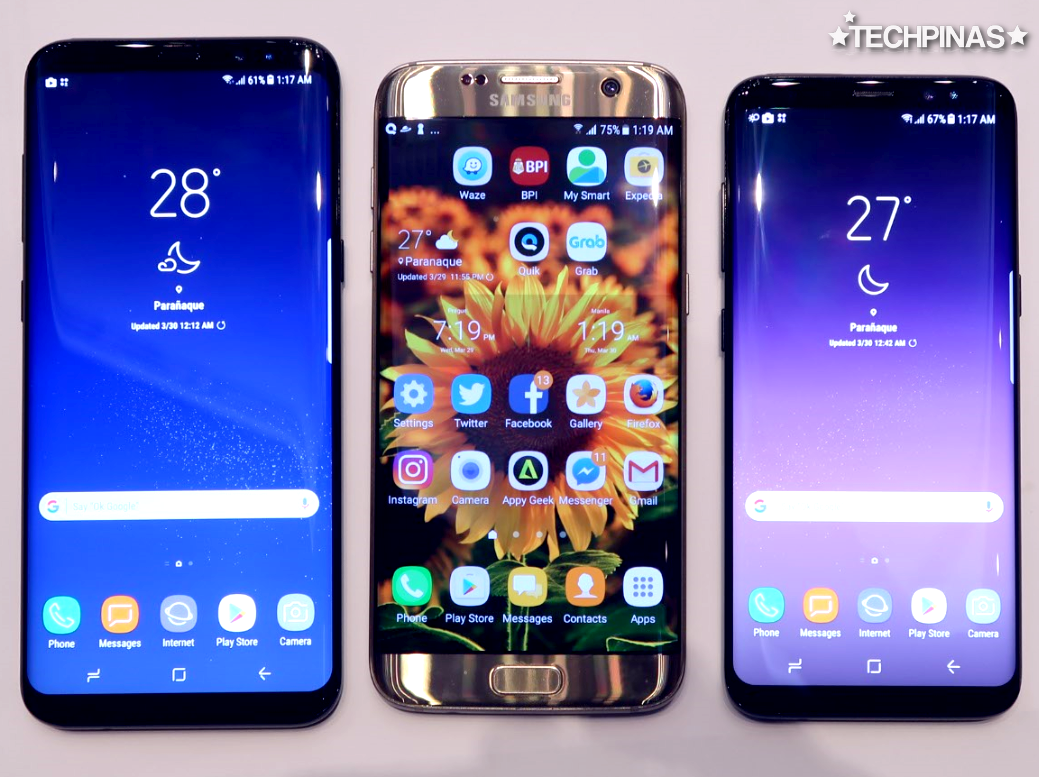
Samsung Galaxy S8+ vs S7 Edge vs S8 Size Comparison Photos

"Sir Mark, is the new Samsung Galaxy S8 notably bigger than my Samsung Galaxy S7 Edge?"

"Given that Samsung Galaxy S8+ has a 6.2-inch screen and that the S7 Edge only has a 5.5-inch display, I'm sure that the new phablet has a far larger footprint than the old one. Can you confirm that, Mark?"

"My SGS7Edge fits in my pocket perfectly. I understand that the Samsung Galaxy S8 has a bigger screen than my current phone -- so I'm afraid it might not fit my pocket just as well. Is that right?"

These are just some of the many 'size related' questions that I got from friends and readers as soon as I arrived home from the Samsung Unpacked event at The City of Dreams Manila last March 29, 2017 where the company officially announced its two new flagship Android smartphones.

Samsung Galaxy S8 Plus vs Samsung Galaxy S7 Edge vs Samsung Galaxy S8

Well, thankfully, Samsung Galaxy S7 Edge is one of my currently daily drivers and I had it with me during Samsung Unpacked, allowing me to snap these shots.

I know a picture paints a thousand words so I'll let these size comparison photos speak for themselves.

Samsung Galaxy S8 Plus vs Samsung Galaxy S7 Edge vs Samsung Galaxy S8
(L-R) 6.2-inch Samsung Galaxy S8+, 5.5-inch Samsung Galaxy S7 Edge, and 5.8-inch Samsung Galaxy S8.

Samsung Galaxy S8 Plus vs Samsung Galaxy S7 Edge vs Samsung Galaxy S8

Here are the dimensions and weight of each model:

Samsung Galaxy S8+
159.5 x 73.4 x 8.1 mm (Length x Width x Thickness)
173 grams

Samsung Galaxy S7 Edge
150.9 x 72.6 x 7.7 mm (Length x Width x Thickness)
157 grams

Samsung Galaxy S8
148.9 x 68.1 x 8 mm (Length x Width x Thickness)
155 grams

SGS8+ is taller, wider, thicker, and heavier than the SGS7Edge. But that's to be expected. What we should note is that despite the sheer screen size difference, the phablets' footprints are still somehow comparable or not that far from each other.


Amazingly, although it has a larger 5.8-inch display versus just 5.5-inch screen on the SGS7Edge, the new Samsung Galaxy S8 is actually smaller, slimmer, and lighter than its predecessor. Sure, the 2017 release is thicker but it's barely noticeable.

So how was Samsung able to make the new flagship models relatively small despite having massive screens? Well, they used a new display resolution of 1440 x 2960 pixels, which is taller than 1440 x 2560 pixels resolution of the SGS7Edge, and removed the physical home button in front. This allowed the new screens to 'eat into' the previously unused space in the top and bottom bezels of the phone. Together, these elements are the foundation of Samsung's new Infinity Display feature.